
Hair Restoration Malaysia: Complete Guide to Hair Transplant & Hair Loss Treatment
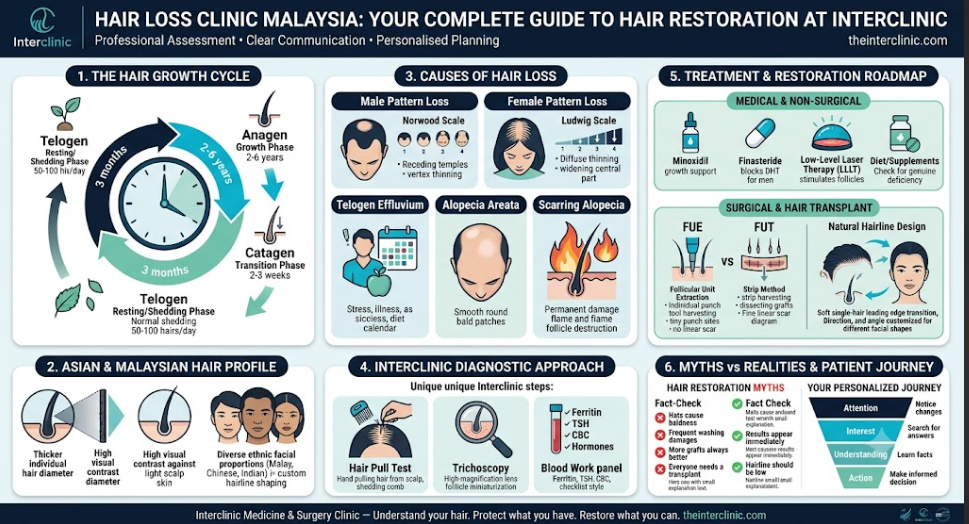
Hair Restoration Malaysia: Your Complete Guide to Restoring Your Hair
Looking for hair restoration Malaysia options can feel overwhelming.
You may have noticed your hairline moving backwards. Perhaps your crown is becoming thinner. Maybe your parting looks wider than before. Or, you may simply feel that your hair does not look as thick as it used to.
At first, the change can seem small.
However, hair loss is often gradual. Because it happens slowly, many people only realise how much hair they have lost when the scalp becomes noticeably visible.
More importantly, hair loss can affect more than your appearance.
It can change how you feel when looking in the mirror. It may affect photographs, social situations and even your confidence at work.
That is why hair restoration is not simply about adding more hair.
It is about understanding why your hair is changing, protecting the hair you still have and, when appropriate, restoring areas that have already become thin or bald.
At Interclinic Medicine & Surgery Clinic, we believe every hair restoration journey should begin with proper assessment.
You may not need surgery.
You may benefit from medical treatment.
Alternatively, if you have established hair loss and a suitable donor area, a hair transplant may become part of your long-term plan.
The right answer depends on your hair, your scalp, your goals and your future.
This guide explains what you need to know before choosing hair restoration in Malaysia.
What Is Hair Restoration?
Hair restoration refers to medical and surgical approaches used to improve the appearance of thinning, receding or lost hair.
Importantly, hair restoration does not automatically mean a hair transplant.
For some people, the first step is medical treatment.
For others, the focus may be on improving hair density or slowing further loss.
Meanwhile, patients with established bald areas may benefit from surgical hair restoration.
Therefore, the best treatment depends on the cause and stage of your hair loss.
Think of it this way.
If a garden is losing plants, you would not immediately buy new plants without checking the soil.
You would first ask why the plants are dying.
Hair works in a similar way.
Before replacing lost hair, you need to understand why the hair is being lost.
That is why a professional hair restoration clinic in Malaysia should begin with diagnosis rather than a package.
Why Does Hair Loss Happen?
Every hair grows from a structure called a hair follicle.
Each follicle follows a natural growth cycle.
First comes the anagen phase, when the follicle actively produces hair.
Next comes the catagen phase, which is a short transition period.
Finally, the follicle enters the telogen phase, when the hair rests before eventually shedding.
After that, the follicle can begin another growth cycle.
Therefore, losing some hair every day is normal.
The problem starts when the balance changes.
Too many follicles may enter the resting phase. Some follicles may gradually become smaller. In other conditions, inflammation can damage the follicle itself.
As a result, the hair becomes thinner, shorter and less visible.
Eventually, some follicles may stop producing meaningful hair altogether.
That is when a person may begin to notice obvious thinning or baldness.
Hair Restoration Malaysia: Why Local Expertise Matters
Malaysia has a diverse population.
Malay, Chinese, Indian and other ethnic groups can have different hair characteristics, facial structures and aesthetic preferences.
Therefore, hair restoration Malaysia should not be approached using one universal template.
Asian hair often has a relatively thick shaft and strong contrast against the scalp.
Consequently, even moderate thinning can become visually obvious.
At the same time, facial proportions influence how a hairline should look.
A hairline that looks natural on one person may look too low or too high on another.
Age matters as well.
So does hairstyle.
Most importantly, future hair loss needs to be considered.
A young patient may want a very low hairline today. However, if the native hair behind that hairline continues to disappear over the next decade, the result may eventually look unnatural.
Therefore, good hair restoration considers both today’s appearance and tomorrow’s hair.
The Most Common Cause: Genetic Hair Loss
One of the most common causes of progressive hair loss is androgenetic alopecia.
It is also known as pattern hair loss.
Both men and women can develop it.
In genetically susceptible follicles, hormonal activity causes gradual miniaturisation.
The follicle becomes smaller.
Then, the hair it produces becomes finer.
Over time, the growth phase may become shorter.
Eventually, the hair can become so fine that it is barely visible.
For men, DHT, or dihydrotestosterone, plays an important role in this process.
However, genetic hair loss does not look identical in everyone.
Male Pattern Hair Loss
Men often notice hair loss around the temples first.
The frontal hairline may gradually move backwards.
For some men, the crown begins thinning at the same time.
Eventually, these areas can become larger and more obvious.
Doctors commonly use the Norwood-Hamilton Scale to describe the progression of male pattern hair loss.
However, the scale alone does not determine whether you need a hair transplant.
Your age, donor density, hair calibre, family history and expected future progression also matter.
For example, a young man with early recession may still have a large amount of hair worth protecting.
Therefore, medical treatment may be considered before surgery.
On the other hand, someone with established baldness may have fewer opportunities to regain density without transplantation.
This is why early assessment matters.
Female Hair Loss
Women can also experience androgenetic alopecia.
However, the pattern is often different.
Rather than a dramatically receding frontal hairline, women may experience diffuse thinning across the top of the scalp.
The centre part may gradually widen.
The scalp may become more visible.
Hair may also feel less dense when tying it up.
Importantly, women can develop hair loss from many different causes.
Hormonal changes, nutritional deficiencies, thyroid conditions and other medical factors can contribute.
Therefore, women should receive an appropriate assessment before considering a surgical hair restoration treatment.
Not Every Case of Hair Loss Needs a Hair Transplant
This is one of the most important things to understand.
Hair loss does not automatically mean you need surgery.
Sometimes, the hair shedding is temporary.
For example, telogen effluvium can occur after significant physical or emotional stress.
Severe illness, high fever, major surgery, rapid weight loss and restrictive diets can disturb the hair cycle.
Interestingly, the shedding may happen weeks or months after the trigger.
Therefore, you may not immediately connect the two events.
Other conditions can also cause hair loss.
Alopecia areata, for example, can cause sudden, smooth patches of hair loss.
Meanwhile, scarring alopecia can damage follicles permanently.
Because these conditions require different approaches, accurate diagnosis matters.
If your hair loss comes with scalp pain, burning, redness, significant scaling or sudden bald patches, seek medical assessment.
How Is Hair Loss Diagnosed?
A good hair restoration clinic Malaysia should begin with understanding your history.
Your doctor may ask:
- When did the hair loss begin?
- Has it progressed slowly or suddenly?
- Does hair loss run in your family?
- Have you recently been seriously ill?
- Have you experienced significant stress?
- Have you lost weight quickly?
- What medications are you taking?
- What treatments have you already tried?
- Are you experiencing scalp symptoms?
After that, the scalp and hair can be examined.
The doctor may assess hair density, miniaturisation, scalp condition and the distribution of hair loss.
In selected situations, additional investigations may be appropriate.
The objective is simple.
Find the cause before choosing the treatment.
This approach can prevent unnecessary surgery and help patients choose a treatment that actually matches their condition.
Non-Surgical Hair Restoration
Modern hair restoration can involve several non-surgical approaches.
One commonly used medication is minoxidil.
It can help support hair growth in suitable patients with certain forms of hair loss.
However, it is not a universal solution.
Another prescription medication is finasteride, which may be considered for suitable male patients.
Finasteride reduces the conversion of testosterone into DHT.
Because DHT contributes to the miniaturisation of susceptible follicles, reducing its effect can help slow progression in appropriate patients.
Nevertheless, finasteride is a prescription medication.
Therefore, patients should discuss its suitability, benefits and potential risks with a doctor.
Can Hair Restoration Work Without Surgery?
Yes.
In the right patient, medical treatment can help preserve existing follicles.
That distinction is important.
Medical treatment is generally about protecting or improving existing hair.
Hair transplantation, on the other hand, is about redistributing hair follicles to areas where hair has already been lost.
Therefore, these approaches can sometimes complement one another.
For example, a patient may use medical treatment to stabilise ongoing hair loss while considering whether a transplant is necessary later.
This is one reason why early consultation can be valuable.
You may have more options before significant follicle loss occurs.
When Is a Hair Transplant Appropriate?
A hair transplant Malaysia procedure may be considered when a patient has suitable donor hair and established areas of permanent hair loss.
The basic principle is straightforward.
Hair follicles are taken from a donor area, usually around the back or sides of the scalp.
They are then transplanted into areas affected by thinning or baldness.
The procedure does not create new follicles.
Instead, it redistributes existing follicles.
Therefore, your donor area is a limited resource.
This is why responsible donor management is one of the most important parts of hair restoration planning.
Taking too many grafts can create visible thinning in the donor area.
Consequently, the goal should not simply be to extract as many grafts as possible.
The goal is to achieve the best long-term result using your available donor resources wisely.
FUE Hair Transplant Malaysia
Follicular Unit Extraction, or FUE, is one of the most commonly discussed hair transplant techniques today.
During FUE, individual follicular units are harvested from the donor area using a small punch.
The grafts are then prepared before being placed into carefully planned recipient sites.
One advantage of FUE is that it does not require removal of a continuous strip of scalp.
Therefore, it avoids the linear donor scar associated with traditional FUT surgery.
This can make FUE attractive to patients who prefer shorter hairstyles.
However, FUE is still a surgical procedure.
The final result depends on more than the extraction method.
Graft selection, handling, storage, implantation, angle, direction and density all matter.
Consequently, choosing a hair transplant clinic Malaysia should involve more than comparing the size of the punch or the number of grafts offered.
FUT Hair Transplant Malaysia
Follicular Unit Transplantation, or FUT, uses a different harvesting approach.
Instead of removing individual grafts directly, the surgeon removes a strip of scalp from the donor area.
The strip is then carefully dissected into individual follicular units.
These grafts can subsequently be transplanted into the recipient area.
FUT can leave a linear scar.
Nevertheless, it remains a technique that may be appropriate for selected patients.
Therefore, FUE and FUT should not be treated as a simple competition.
The better question is:
Which technique is appropriate for your scalp, donor area, lifestyle and long-term goals?
A proper consultation should answer that question.
Natural Hairline Design: The Heart of Hair Restoration
A successful hair transplant is not simply about adding hair.
It is about creating an appearance that looks natural.
Your hairline is one of the most visible parts of your face.
Therefore, even a small design error can become noticeable.
Modern hair restoration uses individual follicular units to create a softer transition.
Single-hair grafts can form the front edge.
Behind them, grafts containing more hairs can gradually increase density.
This creates a more natural visual transition.
Direction matters too.
Natural hair does not grow in perfectly straight rows.
Instead, the angle changes subtly across the scalp.
A good hairline therefore needs to follow the natural flow of your existing hair.
That is where hair restoration becomes both science and artistry.
Designing the Right Hairline for Malaysian Patients
There is no single perfect hairline.
Your ideal hairline should suit your face.
It should also suit your age and hairstyle.
Most importantly, it should make sense for your future hair-loss pattern.
A very low hairline may look attractive immediately.
However, it can become problematic if the native hair behind it continues to recede.
Therefore, a slightly more conservative design may sometimes create a better long-term result.
The goal is not to make you look artificially young.
The goal is to restore a natural frame to your face.
That is the difference between simply transplanting hair and creating a genuine hair restoration plan.
Why More Grafts Do Not Always Mean Better Hair Restoration
One of the biggest misconceptions in hair transplantation is that more grafts automatically produce a better result.
They do not.
Your donor area has a finite number of usable follicles.
Therefore, donor management matters.
Furthermore, graft placement matters.
A poorly designed 4,000-graft transplant may look less natural than a carefully planned 2,500-graft restoration.
Why?
Because visual density does not depend solely on the number of hairs.
It also depends on placement, hair calibre, colour contrast, angle, direction and distribution.
Consequently, do not choose a clinic based only on the biggest graft number.
Look at the quality of the plan.
What Happens After a Hair Transplant?
Many patients expect immediate results.
However, hair restoration requires patience.
During the first week, you may experience redness, mild swelling, crusting or temporary discomfort.
These effects generally improve as the scalp heals.
Then comes a stage that can surprise patients.
The transplanted hairs may shed.
This can look alarming.
However, the follicle can remain inside the scalp even when the visible hair shaft falls out.
After that, the follicle can begin a new growth cycle.
New hair generally appears gradually over the following months.
Therefore, do not judge your final result too early.
Hair grows slowly.
Full maturation can take many months.
Once the transplanted hair has grown, it can generally be cut, washed and styled like your natural hair.
Hair Restoration Is a Long-Term Strategy
A hair transplant may take place in one session.
However, hair restoration is a long-term journey.
Why?
Because your native hair can continue to change.
A patient may have a successful transplant but continue losing untreated hair around the transplanted area.
Consequently, future planning is essential.
For younger patients, this is particularly important.
The objective should be to create a result that remains harmonious as you age.
That means protecting donor reserves.
It also means considering medical treatment when appropriate.
Most importantly, it means avoiding aggressive hairline designs that consume too much donor hair too early.
How to Choose the Best Hair Restoration Clinic in Malaysia
When searching for hair restoration Malaysia, you will find many clinics offering different techniques and packages.
So, how do you choose?
Start with the medical assessment.
A reputable clinic should want to understand your diagnosis before discussing surgery.
Next, ask about the hairline.
Who designs it?
How do they determine the appropriate position?
Then, ask about your donor area.
How much donor hair do you have?
How will it be protected?
You should also understand the recommended technique.
Why FUE?
Why FUT?
Or why medical treatment instead?
Furthermore, ask about realistic expectations.
No responsible clinic should promise impossible density or guaranteed outcomes.
Finally, consider follow-up.
Hair restoration should not end when you leave the procedure room.
Your recovery and long-term hair health matter too.
The Interclinic Approach to Hair Restoration Malaysia
At Interclinic Medicine & Surgery Clinic, we believe hair restoration should be built around the individual.
That means we do not start with:
“How many grafts do you want?”
We start with:
“What is happening to your hair?”
First, we seek to understand your hair-loss pattern.
Next, we assess the scalp and donor area.
Then, we discuss the available options.
Those options may include medical treatment, monitoring, non-surgical approaches or hair transplantation.
Most importantly, the plan should match your goals.
You may want to restore your hairline.
Perhaps you are more concerned about your crown.
Maybe you want to improve overall density.
Alternatively, you may simply want to understand whether your hair loss is getting worse.
Whatever the concern, the first step is understanding the problem.
Hair Restoration Myths and Reality
The internet is full of hair restoration promises.
Some are helpful.
Others can create unrealistic expectations.
Myth: Wearing a Hat Causes Baldness
Normal hat use does not cause genetic pattern baldness.
However, hairstyles that create continuous pulling can contribute to traction-related hair loss.
Myth: More Grafts Always Produce Better Results
Not necessarily.
Donor supply is limited.
Therefore, grafts need to be used strategically.
Myth: Everyone With Hair Loss Needs a Transplant
No.
Some patients may benefit from medical treatment.
Others may have temporary shedding.
Some may have an underlying medical condition.
Myth: Hair Transplant Results Are Immediate
They are not.
Hair follicles need time to go through their natural growth cycle.
Therefore, patience is essential.
Myth: The Hairline Should Be As Low As Possible
A lower hairline is not automatically a better hairline.
The correct position should suit your face, age and future hair-loss pattern.
Frequently Asked Questions About Hair Restoration Malaysia
Is hair restoration suitable for everyone?
No.
Your diagnosis, donor area, scalp condition, age, hair-loss pattern and expectations all influence suitability.
That is why consultation should come before treatment.
Is FUE hair transplant permanent?
Transplanted follicles can provide long-term growth when appropriately selected and transplanted.
However, your original non-transplanted hair may continue to thin.
Therefore, long-term management remains important.
How long does hair restoration take to show results?
Hair grows gradually.
Some early changes may appear within several months, but significant maturation takes longer.
Therefore, patients need realistic expectations.
Can women undergo hair restoration?
Yes.
Selected women can benefit from hair restoration.
However, the cause of female hair loss should first be properly assessed.
Should I choose medical treatment or a hair transplant?
That depends on your condition.
If you still have viable follicles, medical treatment may help protect them.
If you have established permanent baldness, transplantation may be considered.
In some cases, both approaches can work together.
Is FUE better than FUT?
Neither technique is automatically better for everyone.
The appropriate method depends on your donor area, hair-loss pattern, hairstyle, goals and long-term plan.
When Should You Visit a Hair Restoration Clinic?
You do not need to wait until you become completely bald.
Consider an assessment if you notice:
- A receding hairline
- Thinning at the crown
- A widening centre part
- Increasing scalp visibility
- A smaller ponytail
- Sudden heavy shedding
- Bald patches
- Persistent scalp symptoms
- Progressive thinning
- A strong family history of hair loss
Earlier assessment can provide more options.
More importantly, it can replace uncertainty with a clear understanding of your condition.
Your Hair Restoration Journey Starts With Understanding
Hair loss can feel frustrating.
However, you have options.
Modern hair restoration Malaysia combines medical knowledge, surgical techniques and aesthetic planning to help suitable patients improve the appearance of thinning or lost hair.
The most important step is not choosing FUE.
It is not choosing FUT.
It is not choosing the clinic with the biggest graft package.
The first step is understanding your hair.
Understand why it is falling.
Understand what can still be protected.
Understand what has already been lost.
Then, build a plan around those facts.
At Interclinic Medicine & Surgery Clinic, we believe your hair restoration journey should be clear, realistic and personalised.
You may need medical treatment.
You may simply need monitoring.
Or, if you have suitable donor hair and established bald areas, a hair transplant may be part of your long-term restoration plan.
There is no universal solution.
There is only the solution that makes sense for you.
Looking for Hair Restoration Malaysia?
If you are searching for a hair restoration clinic in Malaysia because your hairline is receding, your crown is thinning or your hair density is decreasing, start with a proper assessment.
At Interclinic Medicine & Surgery Clinic, we can help you understand your hair-loss pattern, explore appropriate treatment options and develop a realistic long-term approach to hair restoration.
Your goal is not simply to have more hair.
Your goal is to look natural, feel confident and have a restoration plan that continues to make sense as you grow older.
Interclinic Medicine & Surgery Clinic
Understand your hair.
Protect what you have.
Restore what you can.
Plan for what comes next.
Visit theinterclinic.com to learn more about Hair Restoration Malaysia and arrange a consultation.