
Hair Thinning: Causes, Signs, Treatment and When You Should Take Action
Hair Thinning: Why Is Your Hair Losing Its Fullness?
Have you noticed that your hair does not look as thick as it used to?
Maybe your parting looks wider.
Perhaps your ponytail feels smaller.
You may also notice more scalp when you look at yourself under bright light.
These changes can be subtle at first. However, over time, hair thinning can become much more noticeable.
For many people, the emotional impact can be just as real as the physical change. Your hair is part of how you present yourself. Therefore, seeing your hair become thinner can affect confidence, photographs, hairstyles and even the way you look in the mirror.
The good news is that hair thinning does not always mean permanent baldness.
Different conditions can cause hair to become thinner. Some are temporary. Others are progressive and may need long-term treatment.
That is why the first question should not simply be, “Which product should I use?”
Instead, ask:
“Why is my hair becoming thinner?”
At Interclinic Medicine & Surgery Clinic, we believe that understanding the cause should come before choosing a treatment.
Your age, genetics, medical history, lifestyle, scalp condition and pattern of thinning can all provide important clues.
Once the cause is clearer, you can make a more informed decision about what to do next.
What Does Hair Thinning Actually Mean?
Hair thinning means that your hair has lost some of its overall density or fullness.
It can happen gradually or more suddenly.
Sometimes, individual hairs become progressively finer. In other situations, more hairs enter the shedding phase at the same time.
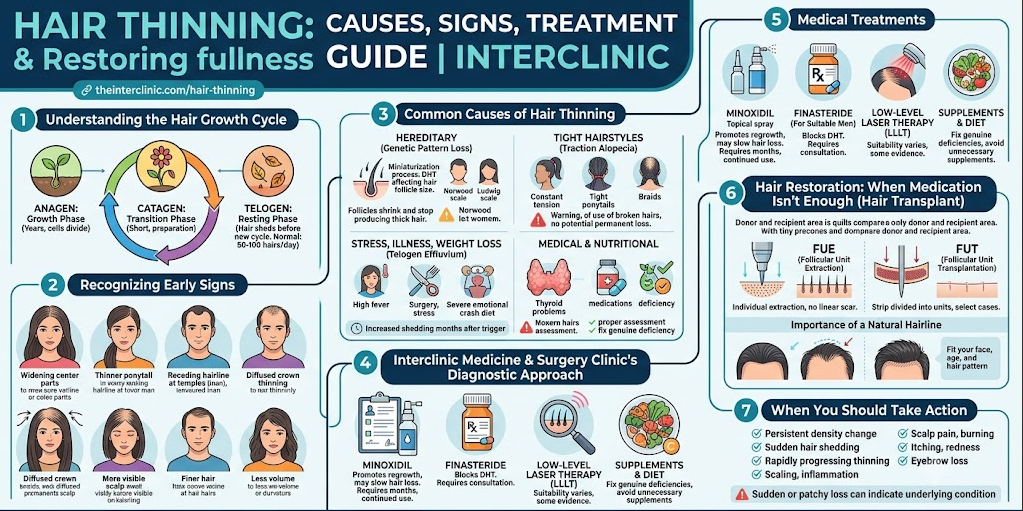
You may notice:
- A wider centre part
- A thinner ponytail
- More visible scalp
- A receding hairline
- Thinning around the crown
- Hair that feels finer than before
- Less volume after washing
- A gradual reduction in overall density
- Small or larger bald patches
Because the change can happen slowly, many people do not notice it immediately.
In fact, you may have hair thinning for months before it becomes obvious.
The American Academy of Dermatology notes that hereditary hair loss is the most common cause of hair loss worldwide. It can appear as overall thinning or a widening part in women, while men often notice a receding hairline or thinning at the crown.
So, if your hair looks different from a few years ago, do not automatically assume that you are simply “getting older”.
Age can contribute, but several other causes are possible.
Understanding the Hair Growth Cycle
To understand hair thinning, it helps to understand how hair normally grows.
Each hair grows from a structure called a hair follicle.
Your follicles do not all grow hair at exactly the same time.
Instead, each follicle moves through its own growth cycle.
The three main stages are called anagen, catagen and telogen.
Anagen: The Growth Phase
The anagen phase is the active growth stage.
During this period, cells within the follicle produce the hair shaft.
This phase can last for years.
Therefore, the length of your hair depends partly on how long individual follicles remain in this growth stage.
Catagen: The Transition Phase
After active growth, the follicle enters the catagen phase.
This is a short transition period.
The follicle becomes smaller and prepares to enter a resting state.
Telogen: The Resting Phase
The final stage is the telogen phase.
During this stage, the hair rests before eventually shedding.
A new growth cycle can then begin.
Some daily shedding is completely normal. Mayo Clinic notes that people typically lose around 50 to 100 hairs each day, although the amount can vary.
The important point is this:
Hair shedding and hair thinning are not always the same thing.
You can shed hair without developing noticeable thinning.
On the other hand, you can gradually lose density even if you do not notice large amounts of hair falling every day.
That difference matters when looking for the cause.
The Most Common Cause: Hereditary Hair Thinning
One of the most common reasons for progressive hair thinning is androgenetic alopecia.
You may know it as male pattern hair loss or female pattern hair loss.
This condition has a strong genetic component.
In susceptible individuals, certain hair follicles become sensitive to androgen hormones, including Dihydrotestosterone (DHT).
Over time, affected follicles can gradually become smaller.
This process is known as miniaturisation.
As the follicle becomes smaller, the hair it produces can become finer and shorter.
Eventually, the hair may become so fine that it is difficult to see.
That is why hereditary hair loss can look like the hair has simply disappeared.
The follicles may still be present, but their ability to produce thick terminal hairs has changed.
The American Academy of Dermatology describes hereditary hair loss as a process in which inherited genes cause hair follicles to shrink and eventually stop producing hair.
Hair Thinning in Men
For men, hereditary hair thinning often follows a recognisable pattern.
The first signs may appear around the temples.
The frontal hairline can gradually move backwards.
Alternatively, some men first notice thinning around the crown.
Over time, these areas can become more obvious.
Doctors often use the Norwood-Hamilton Scale to describe the stages of male pattern hair loss.
However, the number on a scale is less important than understanding what is happening to your hair.
If you notice your hairline changing, an early assessment can be useful.
Treatment for hereditary hair loss tends to work better when started earlier, while there are still follicles that may respond.
That does not mean everyone needs medication or surgery.
Instead, early assessment gives you the opportunity to understand your options before the thinning becomes more advanced.
Hair Thinning in Women
Women can also develop hereditary hair thinning.
This is commonly called Female Pattern Hair Loss (FPHL).
However, the pattern often differs from male pattern hair loss.
A woman may notice:
- A widening centre part
- Less volume at the top of the scalp
- A thinner ponytail
- More visible scalp
- Gradual reduction in overall density
The frontal hairline may remain relatively preserved.
However, not every woman with thinning hair has hereditary hair loss.
Hormonal changes, nutritional problems, thyroid disorders, medications and other medical conditions can also contribute.
Therefore, women should avoid assuming that every case of hair thinning is simply genetic.
A proper assessment can help separate one cause from another.
The AAD specifically recommends diagnosis before treatment because several conditions can look similar while requiring different approaches.
Hair Thinning After Stress, Illness or Weight Loss
Not all hair thinning develops slowly.
Sometimes, a person experiences noticeable shedding several weeks or months after a significant physical or emotional event.
One possible cause is Telogen Effluvium (TE).
This condition can occur after a major stress on the body.
Possible triggers include:
- A significant illness
- High fever
- Major surgery
- Severe emotional stress
- Significant weight loss
- Major dietary restriction
- Hormonal changes
- Childbirth
An important feature is the timing.
The increased shedding may appear months after the triggering event.
Consequently, it can be difficult to connect the two.
For example, you may think, “Nothing has changed recently, so why is my hair suddenly thinner?”
The trigger may have occurred several months earlier.
Fortunately, temporary shedding can improve when the underlying trigger is addressed.
However, persistent thinning still deserves medical assessment.
That is because more than one type of hair problem can occur at the same time.
Can Tight Hairstyles Cause Hair Thinning?
Yes, repeated pulling on the hair can contribute to a condition called traction alopecia.
This can happen with hairstyles that place constant tension on the hair.
Examples include very tight ponytails, braids or other styles that repeatedly pull on the same areas.
At first, the problem may appear as broken hairs or thinning around areas under tension.
However, prolonged traction can potentially cause more permanent hair loss.
Therefore, if your hairstyle causes pain or a strong pulling sensation, it is worth changing the style.
The American Academy of Dermatology recommends reducing tension and seeking professional assessment if hair loss continues.
Other Possible Causes of Hair Thinning
Genetics is important.
Nevertheless, it is not the only explanation.
Hair thinning can also occur because of medical conditions, hormonal changes, certain medications, nutritional problems and physical stress.
For example, thyroid problems can affect hair growth.
Certain medications can also contribute to hair loss.
Nutritional deficiencies may play a role in some patients.
However, this does not mean that every person with thinning hair needs multiple supplements.
In fact, taking unnecessary supplements can sometimes create other problems.
The AAD warns that taking too much of certain nutrients can actually worsen hair loss.
Therefore, it is better to identify a genuine deficiency before taking high-dose supplements.
How Is Hair Thinning Diagnosed?
There is no single test that explains every case of hair thinning.
Instead, the diagnosis starts with a detailed assessment.
At Interclinic Medicine & Surgery Clinic, the doctor may want to understand:
- When the thinning started
- Whether it happened gradually or suddenly
- Which areas are affected
- Whether you have increased shedding
- Your family history
- Recent illnesses
- Changes in weight
- Your diet
- Medications and supplements
- Hormonal or medical history
- Hair-care practices
Next, the scalp and hair can be examined closely.
Hair Pull Test
A Hair Pull Test may help assess whether active shedding is occurring.
The result needs to be interpreted together with your history and scalp examination.
It is not a standalone answer to every hair problem.
Trichoscopy
Trichoscopy allows the scalp and individual hairs to be viewed under magnification.
This can help identify patterns that are difficult to see with the naked eye.
For example, it can assist in assessing hair shaft differences and signs of miniaturisation.
Blood Tests
Blood tests are not automatically necessary for everyone.
However, they may be considered when your history or examination suggests an underlying medical or nutritional problem.
Depending on the individual case, a doctor may consider investigations related to blood count, iron status, thyroid function or other factors.
The key principle is simple:
Do not treat blindly. Find the likely cause first.
Medical Treatment for Hair Thinning
Treatment depends on the cause.
There is no single medicine that works for every type of hair thinning.
For hereditary pattern hair loss, minoxidil is one established treatment option.
Minoxidil can help slow hair loss and may promote regrowth in some people.
However, it takes time.
Mayo Clinic notes that it may take at least several months before the effects become clear, and continued use is generally needed to maintain benefits.
Some people may experience scalp irritation or unwanted hair growth in nearby areas.
For suitable men with male pattern hair loss, finasteride is another prescription option.
Finasteride works by blocking the enzyme that converts testosterone into DHT.
Many men experience a slowing of hair loss while taking it, and some may experience regrowth.
However, finasteride is not suitable for everyone.
It also has potential side effects and important precautions.
Therefore, it should only be used after discussion with an appropriate doctor.
For women, treatment requires particular care because some prescription hair-loss medicines are unsuitable during pregnancy or for women who may become pregnant.
What About Low-Level Laser Therapy?
Low-Level Laser Therapy (LLLT) is another option that has been studied for certain types of hair loss.
It uses low-level light directed at the scalp.
However, it should not be presented as a guaranteed solution.
The evidence and suitability can vary depending on the individual and the type of hair loss.
Therefore, if you are considering LLLT, discuss whether it is appropriate for your specific condition.
The same principle applies to any hair-growth device or supplement:
A treatment should match the problem.
Do Hair Supplements Really Help Hair Thinning?
This is one of the most common questions.
The answer is: sometimes, but not automatically.
If a person has a genuine nutritional deficiency, correcting it may help support normal hair growth.
However, taking supplements without knowing whether you are deficient is not necessarily useful.
More is not always better.
Therefore, focus first on a balanced diet and proper medical assessment.
If your doctor identifies a nutritional problem, treatment can then be directed at that specific issue.
This approach is usually more sensible than buying multiple products based on advertising claims.
When Should You Consider a Hair Transplant?
A hair transplant may be considered when an area has experienced permanent hair loss and suitable donor hair is available.
It is important to understand what a transplant actually does.
A hair transplant does not create new follicles.
Instead, healthy hair follicles are moved from one part of the scalp to another.
Usually, the donor area comes from parts of the scalp that are less affected by pattern hair loss.
The transplanted follicles can then grow hair in the recipient area.
However, not everyone is a suitable candidate.
The doctor needs to consider your donor supply, the pattern of your hair thinning, your scalp condition, your expectations and your likely future hair loss.
The American Academy of Dermatology notes that modern hair transplantation can produce natural-looking results, but the outcome depends significantly on appropriate patient selection and surgical expertise.
Therefore, a good transplant plan should not focus only on filling today’s thin areas.
It should also consider tomorrow.
FUE vs FUT: What Is the Difference?
Two established approaches to hair transplantation are FUE and FUT.
FUE — Follicular Unit Extraction
With FUE, individual follicular units are removed from the donor area using small punches.
The grafts are then prepared and placed into the recipient area.
Because FUE does not involve removing a strip of scalp, it does not create the same linear scar associated with FUT.
However, FUE still involves many small extraction sites.
Therefore, the final appearance depends on factors such as technique, healing and donor-area management.
FUT — Follicular Unit Transplantation
With FUT, a strip of scalp is removed from the donor area.
The strip is then divided into individual follicular units for transplantation.
FUT creates a linear scar.
However, it can be useful in selected patients where the surgeon believes it is appropriate.
So, which method is better?
There is no universal answer.
The best approach depends on the individual.
Your donor density, hair characteristics, expected graft requirements, hairstyle and long-term goals all matter.
A consultation should determine the most suitable option rather than choosing a technique simply because it sounds newer.
The Importance of a Natural Hairline
A successful hair transplant is not just about moving more hair.
It is about placing the hair appropriately.
The hairline is particularly important because it is one of the first things people notice.
A natural hairline should fit your face, age and existing hair pattern.
It should also account for possible future thinning.
Modern transplantation uses individual follicular units to create a more natural transition.
Single-hair grafts can be useful toward the front, while greater density can be placed behind them when appropriate.
The direction and angle of the grafts also matter.
When these details are planned carefully, the transplanted hair can blend more naturally with your existing hair.
Therefore, hair restoration involves both medical planning and aesthetic judgement.
The goal is not simply:
“More hair.”
The goal is:
“Hair that looks like it belongs to you.”
Why Choose Interclinic Medicine & Surgery Clinic?
Choosing where to address your hair thinning is a personal decision.
At Interclinic Medicine & Surgery Clinic, we believe the process should begin with understanding rather than pressure.
You should know what is happening to your hair.
You should understand the available options.
Most importantly, you should understand what treatment can and cannot realistically achieve.
That is why we focus on communication throughout the process.
We explain medical concepts in language that is easier to understand.
We discuss appropriate treatment options based on your individual situation.
We also recognise that hair thinning is not purely a cosmetic concern.
For many people, it can affect confidence and how they feel about their appearance.
Therefore, your concerns deserve to be taken seriously.
At the same time, good medical care means being honest about limitations.
No treatment can guarantee the same result for every person.
Your biology matters.
Your donor supply matters.
Your type of hair thinning matters.
Your expectations matter too.
Common Questions About Hair Thinning
Is hair thinning the same as hair loss?
Not exactly.
Hair loss is a broad term that covers many conditions.
Hair thinning describes a reduction in hair density or fullness.
You can experience thinning because individual hairs become finer, because more hairs are shedding, or because follicles are gradually producing less hair.
Can hair thinning grow back?
Sometimes.
The answer depends on the cause.
Temporary shedding may improve when the underlying trigger resolves.
Some hereditary hair thinning can be slowed or partially improved with treatment.
However, permanently destroyed follicles cannot simply be restored with medication.
That is why diagnosis matters.
Should I wait until my hair becomes very thin?
Not necessarily.
Early assessment can be useful because treatment tends to be more effective when started earlier for many types of hair loss.
You do not need to wait until you have a large bald area.
Does shampoo cause hair thinning?
Ordinary hair washing does not automatically mean you are damaging your follicles.
However, harsh hair practices, excessive tension and certain treatments can damage hair or contribute to hair loss.
If you notice persistent thinning, look beyond shampoo and consider the bigger picture.
Can stress cause hair thinning?
Yes.
A significant physical or emotional stress can trigger temporary increased shedding.
However, stress is not the only possible cause.
If thinning continues, a proper assessment can help identify what else may be contributing.
When Should You See a Doctor?
Consider getting your hair assessed if you notice a persistent change in density.
You should also seek professional advice if you develop:
- Sudden hair shedding
- Rapidly progressing thinning
- A receding hairline
- A widening part
- A growing bald patch
- Thinning around the crown
- Scalp pain or burning
- Significant itching or redness
- Scaling or inflammation
- Hair loss involving the eyebrows
- Hair thinning after significant illness
- Hair thinning following major weight loss
- Hair loss that is causing you significant concern
Sudden or patchy hair loss can sometimes indicate an underlying condition, so it should not simply be dismissed as normal ageing.
Your Hair Thinning Journey Starts With Understanding
Hair thinning can feel frustrating.
You may wonder whether it is temporary.
You may worry that you will eventually become bald.
You may also feel overwhelmed by the number of products and treatments available online.
However, you do not need to guess.
Start by understanding what is actually happening.
Your hair thinning may be related to genetics.
It may be linked to a temporary trigger.
It could involve hormones, nutrition, medication or another medical condition.
In some cases, several factors may exist at the same time.
Once the cause becomes clearer, your treatment options also become clearer.
For some people, monitoring may be appropriate.
For others, medical treatment may help slow progression or support regrowth.
In selected cases, hair transplantation may be considered.
The right answer is not necessarily the most expensive treatment.
It is the treatment that matches your diagnosis, your goals and your long-term situation.
At Interclinic Medicine & Surgery Clinic, our approach begins with that principle.
Understand first. Treat appropriately. Plan for the long term.
Ready to Understand Your Hair Thinning?
You do not have to wait until your scalp becomes clearly visible.
You also do not have to try every hair product you see online.
Most importantly, you do not need to assume that a hair transplant is your only option.
Start with a proper assessment.
At Interclinic Medicine & Surgery Clinic, we can help assess your hair and scalp, explore possible causes and discuss appropriate treatment options based on your individual situation.
Your hair is changing for a reason.
Find the reason. Understand your options. Protect what you still have.
Visit: theinterclinic.com
Interclinic Medicine & Surgery Clinic
Professional assessment. Clear communication. Personalised hair restoration planning.