
Hair Loss: Causes, Types, Treatment & When You Should See a Doctor
Hair Loss: Understanding Why It Happens and What You Can Do
Finding more hair than usual on your pillow, shower floor or bathroom sink can be unsettling.
At first, you may simply think, “Maybe I am just shedding more than usual.” However, when your hairline starts moving backwards, your crown becomes more visible, or your parting looks wider, the concern can become much more real.
Hair loss is extremely common, but that does not mean you should simply ignore it.
In fact, hair loss can happen for many different reasons. Genetics, hormones, stress, illness, nutritional problems, medications, autoimmune conditions and even certain hairstyles can all play a role. Therefore, the right treatment depends on identifying what is actually causing your hair loss in the first place.
At Interclinic Medicine & Surgery Clinic, we believe that treating hair loss should begin with understanding, not guesswork. Instead of immediately recommending a procedure, we look at your pattern of hair loss, scalp condition, medical history and long-term goals.
More importantly, early assessment can give you more options. Some types of hair loss respond well to medical treatment, while others may eventually require hair restoration procedures. The sooner the underlying problem is identified, the better you can plan for the future.
So, if you have started noticing thinning hair, a receding hairline or a bald spot, this guide will help you understand what may be happening and what your next step could be.
What Is Hair Loss?
Hair loss, medically known as alopecia, refers to excessive loss or thinning of hair from the scalp or other parts of the body.
Normally, your hair is constantly going through a natural cycle of growing, resting and shedding. Therefore, seeing some hair fall every day does not automatically mean that you have a medical problem.
Most people naturally shed around 50 to 100 hairs a day. What matters is whether your hair density is gradually decreasing or whether you are developing noticeable areas of thinning or baldness.
For example, you may notice:
- A receding hairline
- A widening part
- A thinner ponytail
- More scalp showing through the hair
- A bald spot developing at the crown
- Sudden patches of missing hair
- Overall thinning across the scalp
- Increased hair shedding several months after an illness or stressful event
Because hair loss can appear gradually, many people do not notice it immediately.
Often, someone else points it out first. A barber may mention that the crown is becoming visible, or a family member may notice that your hairline has changed.
Consequently, taking regular photographs of your hair from the front, top and sides can be useful when monitoring changes over time.
The Hair Growth Cycle: Why Does Hair Fall Out?
To understand hair loss, it helps to understand what happens underneath your scalp.
Each hair grows from a tiny structure called a hair follicle. Your follicles do not all grow hair at the same time. Instead, they move through different stages of a natural growth cycle.
1. Anagen — The Growth Phase
During the anagen phase, the follicle actively produces hair.
This phase can last for several years, depending on your genetics and individual biology. As a result, healthy follicles can produce long, strong hair for a considerable period.
2. Catagen — The Transition Phase
Next comes the catagen phase.
This is a short transitional stage where the follicle reduces its activity and prepares to enter its resting period.
3. Telogen — The Resting Phase
Finally, the follicle enters the telogen phase.
The hair temporarily rests before eventually shedding, allowing the follicle to begin another growth cycle.
Therefore, hair shedding itself is not necessarily a sign of disease.
The problem begins when too many follicles enter the resting or shedding phase, when follicles become progressively smaller, or when inflammation permanently damages the follicle.
That distinction is important because different mechanisms require different treatments.
The Most Common Cause: Pattern Hair Loss
One of the most common causes of hair loss worldwide is androgenetic alopecia, commonly called pattern hair loss. It affects both men and women.
Essentially, genetically sensitive hair follicles gradually become smaller.
In men, this process is strongly influenced by the hormone dihydrotestosterone (DHT). Over time, susceptible follicles may produce progressively finer and shorter hairs.
Eventually, some follicles may produce hair so fine that it becomes difficult to see.
However, pattern hair loss does not look exactly the same in everyone.
Male Pattern Hair Loss
For men, the first signs often appear around the temples, frontal hairline or crown.
Gradually, the hairline may move backwards while the crown becomes thinner. In more advanced cases, these areas may eventually connect.
Doctors commonly use the Norwood-Hamilton scale to describe the progression of male pattern hair loss.
The important point is that you do not need to wait until you become visibly bald before seeking help.
In fact, early treatment can be particularly valuable because treatment may help preserve follicles before they become severely miniaturised.
Female Pattern Hair Loss
Women can also develop androgenetic alopecia, although the pattern often looks different.
Rather than developing a classic receding hairline, many women experience diffuse thinning over the top of the scalp. A widening centre part or a reduction in overall hair volume may be among the earliest noticeable signs.
Meanwhile, the frontal hairline is often relatively preserved.
Because female hair loss can have several possible causes, a proper assessment becomes particularly important. Hormonal changes, nutritional deficiencies, thyroid problems and other medical conditions may need to be considered alongside genetic hair loss.
Hair Loss Is Not Always Genetic
Although hereditary hair loss is extremely common, genetics is not the only explanation.
Sometimes, hair loss begins suddenly after the body has experienced a significant physical or emotional stress.
Telogen Effluvium
Telogen effluvium is one example.
A significant illness, high fever, major surgery, rapid weight loss, crash dieting, severe stress or other major physiological changes can disturb the normal hair cycle.
As a result, more hairs may enter the resting phase and shed later.
Interestingly, the hair loss may become noticeable weeks or months after the triggering event. Therefore, the cause is not always obvious when the shedding actually starts.
In many cases, hair growth can improve once the underlying trigger has been addressed.
Alopecia Areata
Another condition is alopecia areata.
This is an autoimmune condition in which the immune system attacks hair follicles, potentially causing smooth, round patches of hair loss.
The condition can affect the scalp, eyebrows, eyelashes and other body hair.
Because alopecia areata behaves differently from genetic pattern hair loss, simply treating it like male or female pattern baldness may not be appropriate.
Scarring Alopecia
There is also a group of conditions known as scarring alopecias.
In these conditions, inflammation can damage and destroy hair follicles. Once a follicle has been permanently destroyed and replaced by scar tissue, regrowth becomes much more difficult.
Therefore, early diagnosis matters.
If you have hair loss accompanied by scalp pain, burning, significant itching, redness, scaling or areas that look unusually smooth or scarred, you should not simply assume that it is ordinary genetic hair loss.
Other Things That Can Trigger Hair Loss
Besides genetics and medical conditions, several everyday factors can contribute to hair loss or hair breakage.
For example, repeatedly wearing very tight hairstyles can place prolonged tension on the follicles. This condition is called traction alopecia, and continued pulling can eventually cause permanent hair loss.
Similarly, excessive chemical processing, heat and rough hair handling can weaken the hair shaft.
Certain medications and nutritional deficiencies may also contribute.
Meanwhile, hormonal changes can affect hair growth, particularly around pregnancy, after childbirth or during other significant hormonal transitions.
Consequently, “Which shampoo should I use?” is often not the most important question.
A better question is:
“Why am I losing my hair?”
Once you know the cause, you can choose a treatment that actually addresses the problem.
How Is Hair Loss Diagnosed?
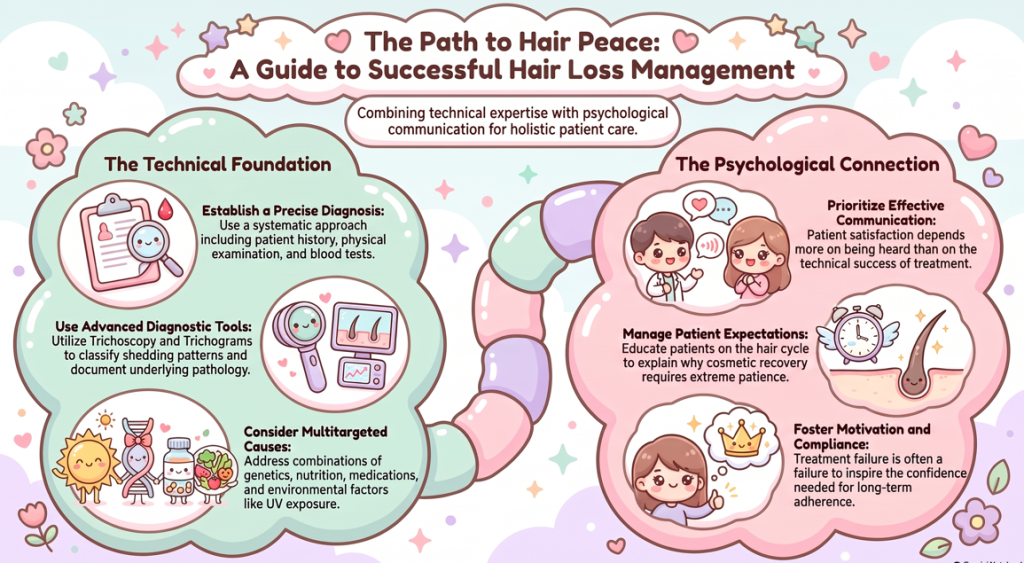
A good hair loss treatment plan begins with a proper diagnosis.
At Interclinic, the consultation should start with your story.
We want to understand when the hair loss started, how quickly it is progressing and which areas are changing. Your family history can also provide useful clues, particularly when pattern hair loss is suspected.
Next, the scalp and hair are examined.
We may look at the density of your hair, the pattern of thinning, the condition of your scalp and the characteristics of the individual hair shafts.
In some situations, additional investigations may be appropriate.
For example, blood tests may help identify issues such as iron deficiency, thyroid dysfunction or other medical factors when your history and examination suggest they may be relevant.
Most importantly, diagnosis helps separate hair shedding from progressive hair loss.
That difference can completely change the treatment strategy.
Hair Loss Treatment: What Are Your Options?
There is no single hair loss treatment that works for everyone.
Instead, treatment depends on the diagnosis, severity, age, sex, medical history, expectations and long-term goals.
Minoxidil
Minoxidil is one of the established medical treatments used for certain forms of hair loss.
It can help reduce hair loss and support hair growth in appropriate patients. However, it is not a universal treatment for every type of alopecia.
Because results take time, patients should have realistic expectations.
Furthermore, continued treatment is generally needed to maintain the benefits.
Finasteride
For appropriate men with male pattern hair loss, finasteride may be prescribed.
Finasteride works by reducing the conversion of testosterone into DHT, which plays an important role in androgenetic alopecia.
Clinical treatment should always take the individual’s circumstances into account because finasteride is a prescription medicine and can cause side effects.
For example, sexual side effects and mood changes have been reported. It is also not a medicine that women who are pregnant or may become pregnant should handle or take without appropriate specialist medical guidance.
Therefore, finasteride should not be treated like an ordinary supplement that you can simply buy and start taking without medical advice.
Low-Level Laser Therapy
Low-level laser therapy (LLLT) is another option that may be considered for certain patients with hereditary hair loss.
The treatment uses low-level light to stimulate cellular activity in the scalp.
However, it should be viewed as part of a broader treatment strategy rather than a miracle cure.
Nutrition and Lifestyle
Your hair also needs an appropriate nutritional environment to grow.
Therefore, if your diet is inadequate or you have a nutritional deficiency, correcting the underlying problem may form part of your treatment plan.
That said, taking large amounts of vitamins does not automatically make hair grow faster.
In fact, excessive amounts of certain nutrients can sometimes worsen hair loss.
When Is a Hair Transplant Appropriate?
Medical treatment can help many patients preserve or improve existing hair.
However, medication cannot recreate every hair that has already been permanently lost.
When suitable patients have areas of established baldness or significant thinning, hair transplantation may become an option.
A hair transplant does not create new hair follicles.
Instead, the procedure redistributes suitable follicles from a donor area, usually from the back or sides of the scalp, into areas affected by hair loss.
Because the donor follicles may be less sensitive to the effects responsible for pattern hair loss, they can provide long-term growth when appropriately selected and transplanted.
Still, not everyone is a suitable candidate.
The amount and quality of donor hair, the pattern of hair loss, scalp health, age and future progression all matter.
Therefore, a good hair transplant plan should consider not only what your scalp looks like today, but also what it may look like years from now.
FUE vs FUT: What Is the Difference?
Two commonly discussed hair transplant techniques are FUE and FUT.
FUE — Follicular Unit Extraction
With FUE, individual follicular units are harvested from the donor area using a small punch.
The grafts are then prepared and placed into the recipient area.
Because FUE does not involve removing a continuous strip of scalp, it does not create the same linear donor scar associated with FUT.
For many patients, this makes FUE an attractive option, particularly for those who prefer shorter hairstyles.
FUT — Follicular Unit Transplantation
With FUT, a strip of scalp is removed from the donor area.
The strip is then carefully dissected into individual follicular units containing one or more hairs before implantation.
FUT can still have a role in carefully selected patients, particularly when a surgeon believes it offers a suitable harvesting strategy.
Therefore, the question should not simply be, “Which technique is better?”
Instead, the more useful question is:
“Which technique is appropriate for my scalp, donor area and long-term hair restoration plan?”
A qualified doctor should assess you before recommending a specific approach.
A Natural Hairline Is About More Than Hair Count
One of the biggest misconceptions about hair transplantation is that more grafts automatically mean a better result.
In reality, naturalness matters more than simply adding hair.
The hairline has to match your facial proportions, age, existing hair pattern and future expectations.
For instance, the angle and direction of each graft influence how naturally the hair sits.
Single-hair grafts are often useful near the leading edge of the hairline because natural frontal hairlines tend to contain finer hairs.
Behind that first zone, the surgeon can progressively increase density using appropriate follicular units.
Consequently, a successful hair transplant is part science and part artistry.
The objective is not to create an unnaturally low teenage hairline.
Instead, the goal is to create a hairline that looks natural today and continues to make sense as you age.
Why Planning Matters in Hair Loss
Hair restoration should not be viewed as a one-time cosmetic decision.
Your hair loss may continue to progress even after a transplant.
Therefore, a responsible treatment plan considers both your current problem and your future.
For example, a young man with early recession may benefit more from stabilising his hair loss and protecting existing follicles before considering surgery.
Similarly, someone with advanced baldness may require careful donor-area assessment and realistic expectations regarding achievable density.
At Interclinic, our approach is therefore centred on understanding the individual rather than applying exactly the same solution to every patient.
What Can You Expect During a Hair Loss Consultation?
A consultation should be a conversation, not a sales presentation.
First, we want to understand what bothers you about your hair loss.
Next, we assess the pattern and possible causes.
Then, we discuss suitable treatment options, including their benefits, limitations, risks and expected timelines.
Most importantly, you should leave the consultation understanding why a particular treatment has been recommended.
You should also feel comfortable asking questions.
For example:
- What type of hair loss do I have?
- Is my hair loss likely to continue?
- Can medication help me?
- Do I actually need a hair transplant?
- How much donor hair do I have?
- What result is realistically achievable?
- What happens if I continue losing hair after treatment?
These are much more important questions than simply asking, “How many grafts can I get?”
Frequently Asked Questions About Hair Loss
Is losing hair every day normal?
Yes. Losing around 50 to 100 hairs a day can be normal. However, visible thinning, a receding hairline, bald patches or a progressively wider part may indicate hair loss that deserves assessment.
Can hair loss grow back naturally?
Sometimes.
Certain types of temporary shedding can improve once the underlying trigger is removed. However, hereditary hair loss and some forms of scarring alopecia may require treatment to prevent further progression or restore lost hair.
Is hair loss caused by stress?
Stress can contribute to some forms of temporary hair shedding, including telogen effluvium.
However, stress is not the explanation for every case of hair loss.
Does wearing a cap cause hair loss?
Ordinary cap use is not generally considered a primary cause of pattern hair loss.
Instead, pay attention to factors such as scalp conditions, tight hairstyles and repeated traction, which can contribute to certain types of hair loss.
Can shampoo stop hair loss?
A shampoo may help keep your scalp and hair clean and healthy, but shampoo alone cannot address every underlying cause of hair loss.
Therefore, if you have progressive thinning, identifying the cause is more important than simply changing shampoos.
Is a hair transplant permanent?
A hair transplant can provide long-term restoration when appropriate donor follicles are selected and the patient is a suitable candidate.
However, your original non-transplanted hair may continue to thin. Consequently, long-term planning remains important.
Is a hair transplant painful?
Hair transplantation is commonly performed using local anaesthesia.
Patients may experience pressure, discomfort or temporary soreness, but the experience varies from person to person.
Your doctor should explain the procedure and expected recovery before treatment.
When Should You See a Doctor About Hair Loss?
You do not have to wait until you are significantly bald.
In fact, early assessment is often more useful because some treatments work better when started before substantial follicle miniaturisation has occurred.
Consider arranging an assessment if you notice:
- Progressive thinning
- A receding hairline
- A growing bald spot
- Sudden heavy shedding
- Round or irregular bald patches
- Scalp pain, burning or significant itching
- Redness or scaling associated with hair loss
- Loss of eyebrows or eyelashes
- Hair loss after a major illness or rapid weight change
- A family history of significant pattern hair loss
Most importantly, do not assume that every case of hair loss needs a hair transplant.
Sometimes the best first step is simply finding the cause and stabilising the condition.
Your Hair Loss Journey Starts With the Right Diagnosis
Hair loss can affect far more than your appearance.
For some people, it changes how they look in photographs. For others, it affects how they feel when meeting people, attending social events or looking in the mirror.
Nevertheless, hair loss does not mean you have to accept uncertainty.
Modern medicine offers several ways to approach hair loss, ranging from diagnosis and lifestyle correction to medical treatment and, when appropriate, hair restoration surgery.
At Interclinic Medicine & Surgery Clinic, our approach begins with understanding your individual situation.
We believe in explaining the options clearly, setting realistic expectations and building a treatment strategy around your long-term goals.
Most importantly, we do not believe that every patient needs the same solution.
Whether you are noticing the first signs of thinning or have been living with advanced hair loss for years, the right place to start is a proper assessment.
Your hair loss has a cause. The first step is finding out what it is.
Ready to understand your hair loss?
Book a consultation with Interclinic Medicine & Surgery Clinic to discuss your hair, scalp and available treatment options.
Visit: theinterclinic.com
Interclinic Medicine & Surgery Clinic
Professional assessment. Clear advice. Personalised hair restoration planning.