
Hair Loss Specialist Malaysia: Understanding Hair Loss, Treatment Options & Hair Restoration at Interclinic
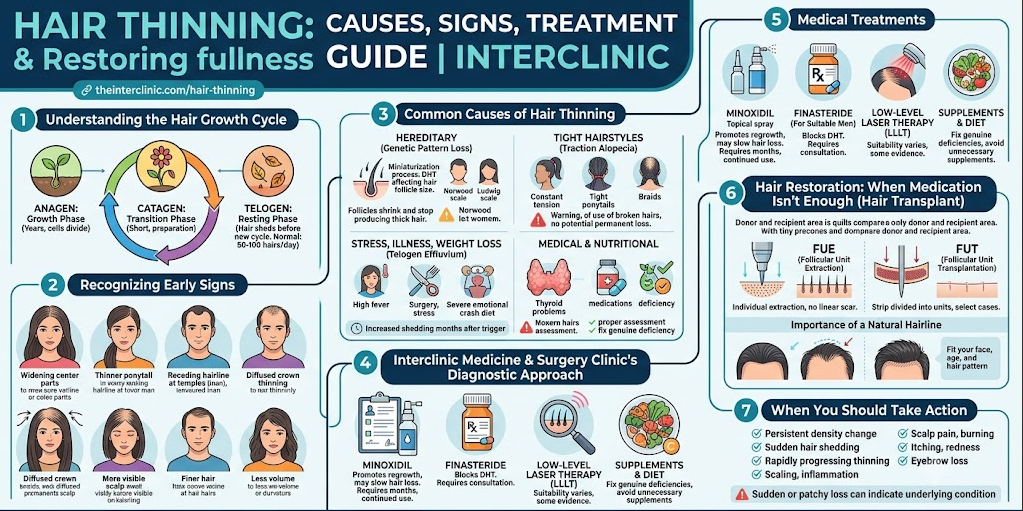
Hair loss can start quietly.
You may notice more hair on your pillow. Perhaps your hairline looks slightly higher than before. Maybe your parting appears wider, or the crown looks thinner when you look in the mirror.
At first, it may not seem serious.
However, gradual hair thinning can become more noticeable over time. More importantly, different types of hair loss can have different causes. Therefore, understanding the reason behind your hair loss is an important first step.
If you are searching for a hair loss specialist Malaysia, Interclinic Medicine and Surgery Clinic provides a medical approach to understanding hair loss, scalp health, and hair restoration.
Our approach begins with assessment. Then, we consider your pattern of hair loss, medical history, scalp condition, lifestyle, expectations, and long-term goals.
Rather than immediately recommending a procedure, the focus is on understanding the problem first.
After all, successful hair restoration is not simply about putting hair into an empty area. It is about understanding why hair is disappearing, protecting the hair you still have, and choosing a treatment strategy that makes sense for your future.
What Does a Hair Loss Specialist Do?
A hair loss specialist focuses on identifying and managing problems involving hair growth, hair thinning, scalp health, and baldness.
Hair loss may appear straightforward. Nevertheless, it can have many possible causes.
Genetics is one of the most common reasons, especially in men. However, hormonal changes, nutritional deficiencies, stress, certain illnesses, medications, scalp conditions, and other factors can also affect hair growth.
Consequently, two people with similar-looking hair loss may need completely different approaches.
A specialist assessment can help distinguish between these possibilities.
For example, male pattern hair loss often follows a recognisable pattern involving the temples, frontal hairline, and crown. Meanwhile, some forms of hair loss may appear suddenly or affect the scalp more diffusely.
Because the underlying cause matters, treatment should follow diagnosis rather than guesswork.
Why See a Hair Loss Specialist in Malaysia?
Malaysia has a wide range of clinics offering hair treatments.
You can find advertisements for hair growth products, scalp treatments, laser devices, injections, supplements, and hair transplant procedures. Therefore, choosing where to start can feel confusing.
A hair loss specialist Malaysia search should not simply lead you to the clinic offering the cheapest package.
Instead, consider the medical assessment behind the treatment.
A good consultation should answer several important questions:
- What type of hair loss do I have?
- Why is my hair thinning?
- Is the hair loss still progressing?
- Can the existing hair be preserved?
- Is medical treatment appropriate?
- Would a hair transplant be suitable?
- How much donor hair do I have?
- What result can realistically be achieved?
- What happens after treatment?
These questions matter because hair restoration is a long-term process.
A treatment that looks attractive today may not be the best choice if it does not account for future hair loss.
Common Causes of Hair Loss
Hair loss does not have just one cause.
Genetic hair loss is extremely common. In men, it is often called male pattern hair loss or androgenetic alopecia.
Women can also experience pattern hair loss. However, the pattern and presentation may differ.
Stress can also affect the hair cycle. In some people, significant physical or emotional stress can contribute to increased shedding.
Nutritional problems may play a role as well. Low levels of certain nutrients can affect normal hair growth, particularly when a deficiency is significant.
Hormonal changes can influence hair too. Medical conditions and certain medications may also contribute.
Furthermore, scalp inflammation or other scalp disorders can affect the hair follicles.
For this reason, assuming that every case of hair loss is simply genetic may lead to the wrong treatment.
Male Pattern Hair Loss
Male pattern hair loss is one of the most common reasons men seek a hair loss specialist in Malaysia.
It typically develops gradually.
The hairline may begin to recede at the temples. Later, thinning can become more noticeable around the crown. Eventually, some men develop more extensive hair loss across the top of the scalp.
However, the speed of progression varies.
Some men experience relatively slow changes over many years. Others notice significant progression at a younger age.
Genetics plays an important role. Hormonal sensitivity within the hair follicles also contributes.
Therefore, early assessment can be useful.
When hair loss is still in its earlier stages, there may be more opportunities to preserve existing hair rather than relying only on transplantation later.
Hair Loss in Women
Women can experience hair thinning for many reasons.
Unlike the classic male pattern, female hair loss may appear as diffuse thinning across the scalp. Some women notice a wider central parting or reduced overall density.
Hormonal changes, genetics, nutritional factors, stress, medical conditions, and other causes may contribute.
Consequently, women should not assume that hair transplantation is automatically the first solution.
The cause needs to be considered.
A medical assessment may help determine whether the hair follicles remain active, whether increased shedding is occurring, or whether another condition needs attention.
Once the likely cause is understood, the treatment plan can become more focused.
Why Early Hair Loss Assessment Matters
Many people wait until their hair loss becomes obvious.
Unfortunately, waiting can sometimes reduce the options available later.
Hair follicles that have become severely miniaturised may be difficult to restore. Meanwhile, progressive hair loss can continue around transplanted areas.
Therefore, early assessment can have an important role.
You do not necessarily need a hair transplant simply because you notice thinning.
In fact, some people may benefit more from medical management, observation, lifestyle changes, or a combination of approaches.
The earlier you understand the situation, the more informed your decisions can become.
Hair Loss Treatment Should Protect Existing Hair
Hair restoration is not only about replacing lost hair.
Protecting the hair that remains is equally important.
Imagine planting new trees while allowing the existing trees to disappear. The overall landscape would still change over time.
The same principle applies to hair restoration.
A hair transplant can move follicles from one area to another. However, it does not necessarily stop future thinning of untreated hair.
Consequently, a long-term hair restoration strategy may need to consider both existing and transplanted hair.
This is why consultation matters before choosing a procedure.
Medical Hair Loss Treatment
Depending on the diagnosis, some patients may be suitable for medical treatments designed to reduce hair loss or support hair growth.
The specific treatment depends on the individual.
Medical treatments can have potential side effects and contraindications. Therefore, they should not be started casually based on advice from social media or online forums.
A doctor can discuss whether a particular medication or treatment is appropriate.
Moreover, treatment results can take time.
Hair grows slowly. Consequently, patients should usually expect gradual rather than overnight changes.
Consistency is often more important than chasing a new product every few weeks.
Hair Growth Treatments
The hair restoration industry offers many treatment options.
Some involve topical products. Others use oral medication, injections, devices, or combinations of treatments.
Examples that may be discussed in appropriate cases include topical treatments, prescription medication, platelet-rich plasma or PRP-based approaches, and other medical hair restoration techniques.
However, evidence and suitability vary between treatments.
Therefore, a responsible hair loss specialist Malaysia should explain what is known about the treatment rather than promising guaranteed regrowth.
No treatment works equally well for every person.
Your age, diagnosis, stage of hair loss, health, genetics, and treatment adherence can all affect the outcome.
What Is a Hair Transplant?
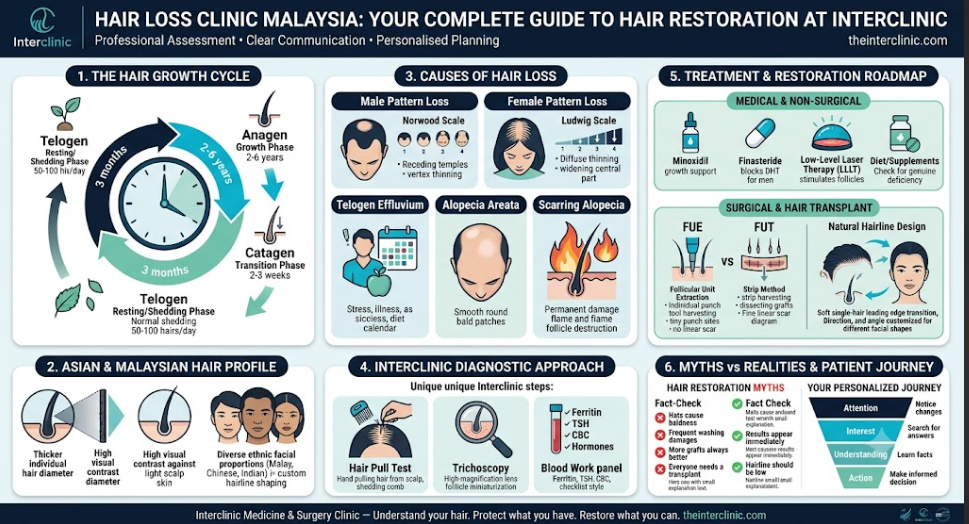
A hair transplant is a surgical hair restoration procedure.
Instead of creating new hair follicles, the procedure relocates existing follicles from a donor area to areas affected by hair loss.
The donor area is commonly located toward the back and sides of the scalp because these follicles may have greater resistance to pattern hair loss.
However, donor hair is limited.
That limitation is extremely important.
A person cannot simply receive unlimited grafts. The available donor supply must be planned carefully.
Therefore, a good hair transplant strategy considers both the current problem and future hair loss.
FUE Hair Transplant
FUE hair transplant, or follicular unit extraction, is a widely used hair transplantation technique.
With FUE, individual follicular units are extracted from the donor area and subsequently placed into the recipient area.
The procedure requires careful planning.
The direction, angle, spacing, and distribution of grafts can influence the appearance of the final result.
For example, the frontal hairline requires particularly careful planning because it is highly visible.
A natural hairline should not look like a straight row of implanted hairs.
Instead, it should complement the patient’s facial structure and age.
What Makes a Hair Transplant Look Natural?
People often focus on the number of grafts.
However, graft numbers alone do not determine whether a hair transplant looks natural.
Hairline design matters.
Graft placement matters.
Hair direction matters.
Donor management matters.
Furthermore, future hair loss matters.
A younger patient may have significant hair loss in the future. Therefore, using too much donor hair at the front today may create problems later.
A good plan should consider the patient’s long-term appearance.
That is why choosing a hair loss specialist in Malaysia should involve more than comparing graft prices.
Hair Transplant for Receding Hairline
A receding hairline is often one of the first visible signs of male pattern hair loss.
Some men become particularly self-conscious about their temples. Others feel that their forehead has become too prominent.
A hair transplant may be considered when the patient is suitable.
Nevertheless, restoring the hairline requires careful planning.
The hairline should reflect the patient’s facial proportions. It should also allow for future ageing.
Consequently, the goal is not necessarily to create the lowest possible hairline.
Instead, the objective is to create a natural-looking hairline that remains appropriate over time.
Hair Transplant for Crown Hair Loss
Crown thinning presents a different challenge.
The crown has a circular growth pattern, known as a whorl. Therefore, placing grafts in this area requires attention to natural hair direction.
Moreover, crown restoration can consume a significant amount of donor hair depending on the size of the thinning area.
For that reason, the doctor should consider whether crown transplantation is the best use of available donor follicles.
Sometimes, preserving existing crown hair may be a more important priority.
How Many Hair Grafts Do You Need?
There is no universal number.
The number of grafts depends on the size of the area being treated, the existing density, donor supply, hair characteristics, and desired coverage.
A patient with a small receding hairline may require fewer grafts than someone with extensive frontal and crown thinning.
However, more grafts do not automatically mean better results.
Using too many grafts can unnecessarily reduce the donor reserve.
Therefore, graft planning should be based on the individual rather than a standard package.
Hair Restoration Is a Long-Term Strategy
Hair restoration should not be viewed as a single event.
Your hair continues to age after treatment.
Natural hair can continue thinning. Hair texture can change. Your appearance can also change as you get older.
Therefore, a good hair restoration plan considers the future.
This may involve protecting existing hair, monitoring progression, maintaining realistic expectations, and considering additional treatment only when appropriate.
As a result, the best hair transplant is not necessarily the largest one.
It is the one that makes sensible use of your available resources while creating a natural and sustainable result.
Choosing a Hair Loss Specialist Malaysia
When searching for a hair loss specialist Malaysia, consider several factors.
First, look at the medical background and experience of the doctor.
Next, understand how the clinic assesses hair loss.
Then, ask whether the clinic discusses both medical treatment and surgical options where appropriate.
You should also ask about donor assessment.
Additionally, request clear information about recovery, possible risks, expected results, and follow-up.
Before-and-after photographs can be useful. Nevertheless, they should not be the only factor you consider.
Different patients have different starting points.
Hair thickness, colour, skin tone, donor density, degree of baldness, and photographic conditions can all affect how results appear.
Therefore, a personal consultation remains important.
Be Careful With Guaranteed Hair Growth Claims
Hair loss can make people vulnerable to exaggerated promises.
You may see advertisements claiming rapid regrowth, guaranteed results, or revolutionary treatments.
However, biology does not always work that way.
Hair follicles respond differently from person to person.
Consequently, a responsible clinic should explain realistic outcomes rather than guarantee perfection.
You should also be cautious when a treatment is presented as suitable for everyone.
A good medical treatment begins with patient selection.
Sometimes the appropriate answer is different from what you expected.
That honesty is valuable.
Hair Restoration and Your Confidence
Hair loss is not a medical emergency for most people.
Nevertheless, it can have a significant psychological and social impact.
Some people avoid photographs. Others wear hats more often. Some feel uncomfortable meeting people or speaking in public.
Business owners and professionals may also feel that their appearance no longer reflects how energetic they feel inside.
These feelings are real.
However, hair restoration should be approached carefully.
The goal should not be to create an unrealistic version of yourself.
Instead, treatment can help you feel more comfortable with your appearance.
Confidence should come from a sensible treatment plan and realistic expectations.
Hair and Scalp Health Matter Too
Hair follicles do not exist in isolation.
The scalp is living tissue.
Therefore, scalp health can affect the environment in which hair grows.
Conditions such as inflammation, excessive oiliness, dandruff, or other scalp problems may require attention.
A hair loss consultation should therefore consider the scalp as well as the hair itself.
Furthermore, lifestyle factors can influence overall health.
Sleep, nutrition, stress management, exercise, and general wellbeing all contribute to the body’s ability to function normally.
These factors do not magically reverse genetic baldness. However, maintaining good general health remains important.
What Happens During a Hair Loss Consultation?
A consultation should feel like a conversation rather than a sales presentation.
First, the doctor will usually discuss your hair loss history.
You may be asked when you first noticed thinning, whether your hair loss has progressed, and whether other family members experience similar problems.
Next, the scalp and hair pattern can be assessed.
The doctor may also discuss previous treatments and relevant medical history.
Depending on the situation, additional investigation may be appropriate.
After that, possible treatment options can be explained.
These may include monitoring, medical treatment, hair restoration procedures, or a combination.
Most importantly, you should leave the consultation understanding your options.
Questions to Ask Your Hair Loss Specialist
Before starting treatment, consider asking:
- What type of hair loss do I have?
- What is likely causing it?
- Is my hair loss still progressing?
- Can my existing hair be preserved?
- Am I suitable for a hair transplant?
- How strong is my donor area?
- How many grafts might I realistically need?
- What result can I expect?
- What are the risks?
- How long will recovery take?
- Will I need ongoing treatment?
- What happens if I continue losing hair?
These questions can help you compare clinics more intelligently.
They can also help you understand whether a proposed treatment fits your long-term goals.
Why Interclinic Focuses on Individual Hair Restoration
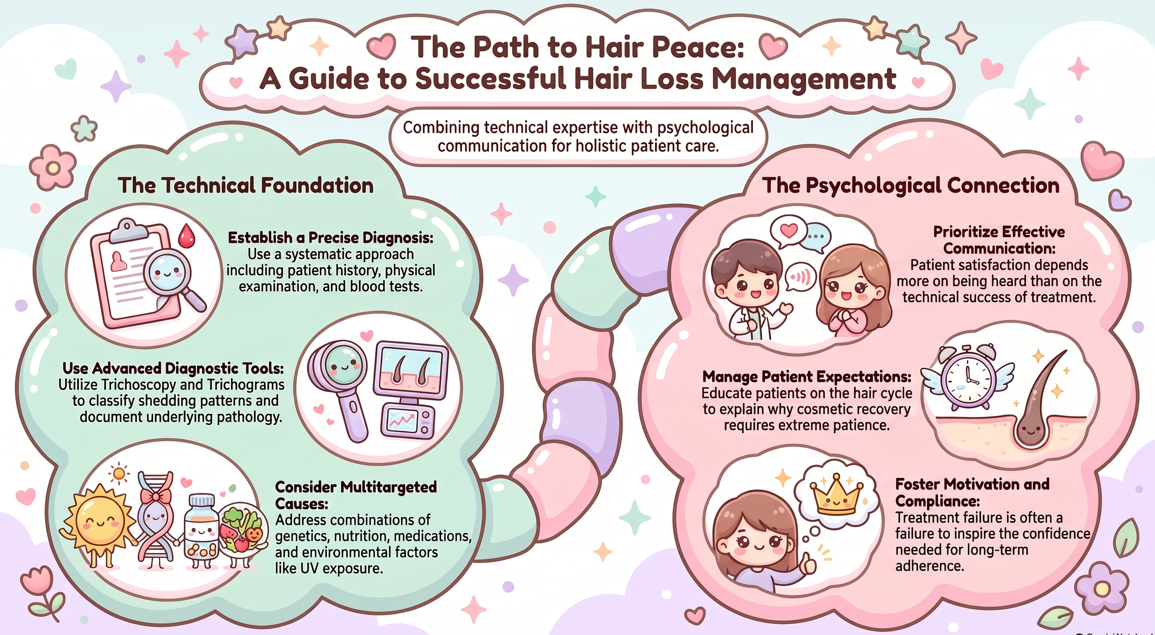
At Interclinic Medicine and Surgery Clinic, we understand that hair loss is personal.
Some patients want to restore a receding hairline.
Others want to improve thinning at the crown.
Some are only beginning to notice changes and want to understand their options before the problem progresses.
Therefore, we do not believe that every patient needs the same solution.
Our approach starts with assessment.
Then, we discuss the available options.
If a hair transplant is appropriate, we can discuss the principles of hair restoration and what may realistically be achieved.
If another approach is more suitable, that should also be part of the conversation.
The aim is straightforward: help you make a medically informed decision.
Your Hair Restoration Journey Should Be Personal
There is no universal perfect hairline.
There is no universal number of grafts.
There is also no universal treatment that works for everyone.
Instead, successful hair restoration depends on matching the right approach to the right patient.
Your age matters.
Your pattern of hair loss matters.
Your donor supply matters.
Your expectations matter.
Most importantly, your long-term goals matter.
Therefore, take your time before making a decision.
Research the clinic.
Understand the procedure.
Ask questions.
Then choose a medical team you feel comfortable trusting.
When Should You See a Hair Loss Specialist?
You do not have to wait until you develop obvious baldness.
Consider an assessment if you notice:
- Increasing hair shedding
- A receding hairline
- Thinning around the crown
- A wider parting
- Reduced overall hair density
- A visible scalp through the hair
- Sudden changes in hair growth
- Persistent scalp problems
- Hair loss that concerns you emotionally
Early assessment does not mean you need treatment immediately.
Instead, it gives you information.
That information can help you decide whether monitoring, medical treatment, hair restoration, or another approach is appropriate.
Take the First Step Before Hair Loss Takes Over
Hair loss rarely changes overnight.
That is actually good news.
It means you have time to understand what is happening and make a considered decision.
If you are searching for a hair loss specialist Malaysia, start with a proper medical assessment rather than jumping directly into a procedure.
At Interclinic Medicine and Surgery Clinic, we believe hair restoration should combine medical assessment, realistic expectations, careful planning, and long-term thinking.
Whether your concern is a receding hairline, thinning crown, general hair loss, or early signs of baldness, the first step is understanding the cause.
From there, the right path becomes clearer.
You may need medical treatment.
You may need monitoring.
You may be a candidate for a hair transplant.
Or you may benefit from a combination of approaches.
The important thing is to choose based on your individual situation.
Start Your Hair Restoration Consultation at Interclinic
Your hair is part of your appearance. More importantly, your confidence and wellbeing matter.
If hair loss is affecting how you feel about yourself, you do not have to ignore it.
Speak with a medical professional. Ask questions. Understand your options.
At Interclinic Medicine and Surgery Clinic, our approach to hair loss focuses on personalised assessment and realistic treatment planning.
If you are looking for a hair loss specialist in Malaysia, contact our clinical team to discuss your concerns and find out which options may be suitable for you.
Interclinic Medicine and Surgery Clinic
No. 7, Jalan USJ 21/10, USJ 21, Subang Jaya, Selangor
Phone: 018-3525359
Website: theinterclinic.com
Your hair restoration journey starts with understanding your hair loss. Start with a consultation.