
Hair Transplant Recovery: Your Complete Guide to Healing, Aftercare & Results in Malaysia
Hair transplant recovery is one of the most important parts of your hair restoration journey. The procedure itself may take only several hours, but your scalp and transplanted follicles need much more time to heal, settle and grow.
After surgery, it is normal to feel excited. At the same time, you may have questions about redness, swelling, scabs, washing, exercise, hair shedding and the final result. Understanding what happens next can make the recovery period much easier.
At InterClinic Medicine & Surgery Clinic, we believe that successful hair restoration involves more than the procedure itself. Proper assessment, careful surgical planning, aftercare and long-term monitoring all matter.
Whether you are considering FUE, FUT or a combination of hair restoration treatments, knowing what to expect can help you approach your recovery with realistic expectations.
This guide explains the hair transplant recovery timeline, including what may happen during the first few days, the shedding phase, early hair growth and the gradual development of your final result.
Why Hair Transplant Recovery Matters
A hair transplant does not create an instant full head of hair.
During the procedure, hair follicles are carefully harvested from a donor area and placed into areas affected by hair loss. Afterward, your scalp needs time to heal while the transplanted follicles adapt to their new location.
For that reason, the recovery period deserves as much attention as the procedure itself.
During the early stage, protecting the recipient area is particularly important. Your scalp may be sensitive, while the newly placed grafts require gentle handling.
As healing progresses, the focus gradually changes.
First, the priority is protecting the grafts.
Then, the goal becomes maintaining a healthy scalp.
Later, attention shifts toward monitoring new growth and protecting your existing hair.
The exact experience differs from person to person. Your procedure type, number of grafts, scalp condition, general health and individual healing response can all influence recovery.
Therefore, avoid comparing your recovery too closely with someone else’s experience online.
Your hair transplant recovery is personal.
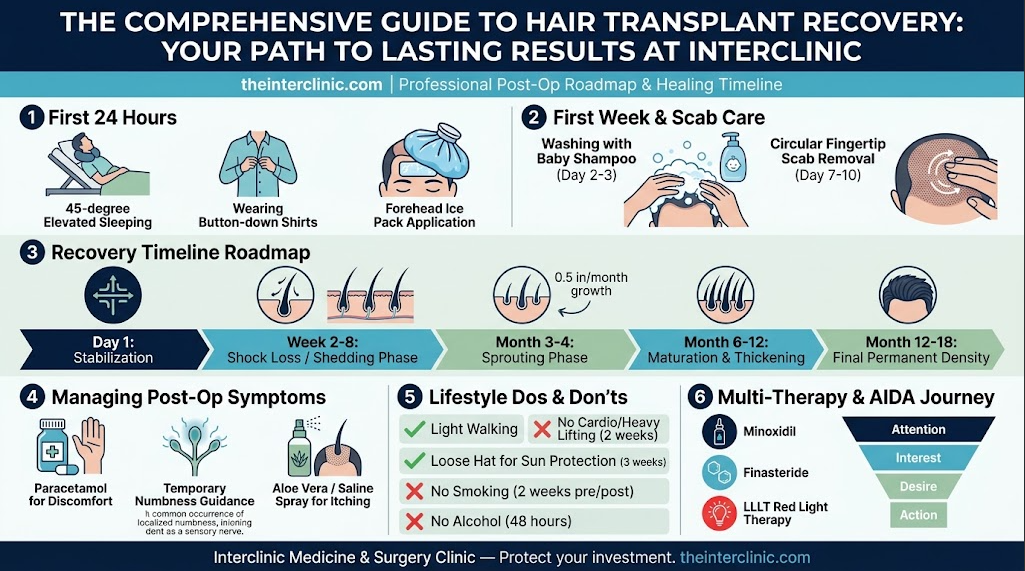
The First 24 Hours: Protect Your Newly Transplanted Grafts
The first day is an important part of your recovery.
Immediately after the procedure, your scalp may look red or slightly swollen. You may also notice tiny crusts around the transplanted follicles.
These changes can be expected after hair transplantation.
However, the area needs to be treated gently.
Avoid unnecessary touching, rubbing or scratching. You should also follow the specific instructions provided by your doctor regarding washing, sleeping and medication.
Be Careful With Your Clothing
Getting dressed sounds simple.
Nevertheless, pulling a T-shirt over your head can cause unnecessary contact with the scalp during the early recovery period.
A button-down or zippered shirt may therefore be more convenient during the first few days.
The principle is simple:
Avoid unnecessary friction around the transplanted area.
How Should You Sleep?
Sleeping can feel slightly awkward after a hair transplant.
Many patients find it more comfortable to sleep with the head elevated during the first few nights. This position may also help reduce swelling.
A neck pillow can provide additional support.
Most importantly, avoid placing unnecessary pressure directly on the recipient area.
If your doctor gives you specific sleeping instructions, follow those instructions rather than relying on general advice.
Swelling After Hair Transplant
Some swelling can occur during hair transplant recovery.
In certain patients, swelling becomes more noticeable during the first few days. It may affect the forehead and, occasionally, the area around the eyes.
Although this can look alarming, mild swelling does not automatically mean something is wrong.
Your clinic may provide specific instructions for managing it.
For example, your doctor may recommend a particular way to use a cold compress. Do not place ice directly onto freshly transplanted grafts unless specifically instructed to do so.
Furthermore, contact your clinic if swelling becomes unusually severe or is accompanied by increasing pain, fever, pus or other concerning symptoms.
Early communication is always better than trying to manage an unexpected problem on your own.
Days 2 to 7: The Early Healing Stage
During the first week, your scalp begins to heal more actively.
Small crusts or scabs may develop around the transplanted grafts. They can make the recipient area look dotted or rough.
This appearance can be surprising.
However, crust formation is a normal part of wound healing after hair transplantation.
The important point is not to pick at the crusts.
Pulling or scratching them prematurely can irritate the healing skin and may interfere with the recovery process.
Instead, follow your clinic’s washing instructions carefully.
The way you wash your scalp during this period is particularly important.
When Can You Wash Your Hair After a Hair Transplant?
This is one of the most common questions patients ask.
There is no single washing schedule that applies to every patient.
The appropriate timing can depend on the surgical technique, your scalp condition and your surgeon’s preferred protocol.
At InterClinic, patients receive specific post-operative instructions for scalp care after their procedure.
During the early stage, washing should generally be gentle.
Avoid directing a powerful shower stream directly onto the recipient area.
Likewise, avoid aggressive rubbing or scratching.
Instead, use the cleansing method recommended by your medical team.
As the scalp heals, your doctor may allow you to gradually return to a more normal washing routine.
Remember that generic online advice should never replace the instructions given by the doctor who performed your procedure.
Your personalised aftercare instructions should always take priority.
The First Week: Protecting Your Hair Transplant
The first week is a time to be careful.
You may begin feeling much better after several days. Consequently, it can be tempting to return immediately to your normal routine.
However, your scalp is still healing.
Avoid activities that could cause significant sweating, friction, pressure or impact.
Do not scratch the recipient area.
Do not pull at scabs.
Avoid unnecessary manipulation of the grafts.
At the same time, continue following your prescribed medication and washing routine.
Your clinic may also schedule an early follow-up to assess healing.
A follow-up gives your doctor an opportunity to check the scalp, answer questions and identify anything that requires attention.
Week Two: Your Scalp Starts Looking More Normal
By around the second week, many patients notice that the scalp looks considerably calmer.
Crusting gradually decreases.
Redness may also begin to fade.
For FUE patients, the small extraction points in the donor area usually become less noticeable as healing progresses.
Nevertheless, do not expect a thick new hairline yet.
Hair transplantation works according to the natural growth cycle of hair.
The transplanted follicles need time before producing visible new growth.
This is why the second week is primarily a healing milestone, not a final-results milestone.
Patience remains important.
Shock Loss: Why Does Hair Fall After a Hair Transplant?
This is perhaps the most emotionally challenging part of hair transplant recovery.
You had a transplant because you wanted more hair.
Then, several weeks later, some of the transplanted hair may fall.
Naturally, you may wonder:
“Did my hair transplant fail?”
Not necessarily.
Temporary shedding can occur after hair transplantation. This phenomenon is commonly referred to as shock loss.
The surgical process can temporarily disturb the normal hair growth cycle.
As a result, some hair shafts may enter a resting phase and shed.
Importantly, the visible hair shaft is not the same thing as the follicle beneath the skin.
Therefore, seeing transplanted hairs fall does not automatically mean that the underlying follicles have been lost.
Some patients may also experience temporary thinning of existing hair around the transplant area.
However, unusual or severe hair loss should always be discussed with your doctor.
The “Ugly Duckling” Phase
The recovery period can sometimes look worse before it looks better.
This stage is often called the “ugly duckling phase.”
Your transplanted area may look thin.
Some existing hairs may have shed.
The new hairs may not yet be visible.
Consequently, you might feel that your appearance has not changed much.
That is understandable.
Nevertheless, this stage does not represent the final outcome.
Hair follicles follow their own biological growth cycle. They do not respond to impatience.
For many patients, visible new growth begins around the third or fourth month. However, individual timelines vary.
Therefore, avoid judging your transplant based on how it looks during the first few weeks.
The early appearance is not the final result.
Months 3 to 4: Early New Hair Growth
Around the third or fourth month, many patients begin seeing the first signs of new growth.
Initially, the hairs may be very fine.
They may also look lighter or thinner than your mature hair.
That is normal.
Newly emerging hair does not necessarily look thick immediately.
Instead, the hair gradually becomes longer and can increase in calibre as it matures.
At this stage, you may notice small hairs appearing along your new hairline or within previously thinning areas.
For many patients, this is an exciting milestone.
However, resist the temptation to judge density too early.
The growth process is still developing.
Months 6 to 9: Noticeable Improvement
By around six months, the transformation can become much easier to see.
New hairs continue to grow.
At the same time, the shafts may become thicker and blend increasingly well with your existing hair.
The overall appearance can therefore start to look more natural and fuller.
Nevertheless, progress varies between individuals.
Some patients develop visible density earlier, while others require more time.
Your donor characteristics, recipient area, graft characteristics, hair calibre and individual growth cycle can all influence the final appearance.
For this reason, progress photographs are extremely useful.
A change that seems insignificant when viewed every morning can become obvious when you compare photographs taken several months apart.
Months 12 to 18: Hair Maturation
Many people think the one-year mark represents the absolute end of hair transplant recovery.
In reality, some patients may continue seeing maturation beyond 12 months.
The hair may gradually become thicker.
Texture may improve.
The transplanted hairs may blend more naturally with your surrounding hair.
Consequently, the final appearance can continue developing after the first year.
Some patients may need up to 12–18 months to appreciate the full maturation of their result.
Therefore, avoid making major decisions about a second procedure too early.
Your doctor can assess your progress and determine whether additional density is appropriate once sufficient time has passed.
Hair Transplant Recovery: What Should You Do?
1. Follow Your Doctor’s Instructions
This is the most important rule.
You will find thousands of hair transplant recovery tips online.
Some may be useful.
Others may not apply to you at all.
Your surgeon understands the technique used, the number of grafts placed and your individual scalp condition.
Therefore, your personalised instructions should take priority.
2. Avoid Scratching
Itching can occur during healing.
Although scratching may provide temporary relief, it can irritate the skin and potentially interfere with healing.
If the itching becomes difficult to manage, speak with your clinic.
Your doctor can recommend an appropriate approach based on your recovery.
3. Protect Your Scalp From Excessive Sun Exposure
Freshly treated skin can be more sensitive to sunlight.
Therefore, take sensible precautions during the early recovery period.
Ask your doctor when it is appropriate to use a hat or other form of protection.
Avoid exposing the healing scalp to prolonged, intense sunlight.
Later, once the skin has recovered sufficiently, regular sun protection remains a good long-term habit.
4. Avoid Strenuous Exercise Too Early
Exercise is healthy.
However, returning to intense exercise immediately after surgery may not be appropriate.
Heavy lifting, intense cardio and activities that cause substantial sweating may need to be restricted temporarily.
Light walking may be suitable earlier for some patients.
Nevertheless, your doctor should determine when you can resume more demanding exercise.
Contact sports require additional caution because accidental impact can injure the scalp.
When Can You Return to Work?
The answer depends largely on the type of work you do.
Someone working at a desk may return to normal activities sooner than someone working outdoors or performing heavy physical labour.
FUE patients often experience a relatively short recovery period, although visible redness and scabbing can still affect their appearance temporarily.
FUT patients may require additional time because the donor area contains a linear surgical wound.
Consequently, your return-to-work plan should take both healing and the physical demands of your job into account.
If appearance is important for your profession, you may also want to consider how long redness or crusting could remain visible.
Swimming, Sauna and Water Activities
Swimming should generally be postponed during the early recovery period.
Swimming pools contain chemicals that can irritate healing skin. Open water also introduces environmental factors that may not be ideal for a freshly treated scalp.
Similarly, saunas and activities that cause significant heat and sweating may need to be avoided temporarily.
Therefore, wait until your doctor confirms that your scalp has recovered sufficiently.
Do not assume that because the scalp “looks fine,” it is automatically ready for every activity.
Healing beneath the surface can continue even when the skin looks normal.
Smoking and Alcohol During Hair Transplant Recovery
Lifestyle choices also matter during recovery.
Nicotine can affect blood vessels and may interfere with normal healing.
For that reason, smokers should discuss appropriate smoking cessation advice with their doctor before undergoing surgery.
Alcohol also requires caution around the time of surgery.
Depending on your medication and individual circumstances, your doctor may advise you to avoid alcohol for a certain period before and after the procedure.
Do not restart alcohol simply because you feel well.
Instead, follow your clinic’s specific instructions.
Nutrition During Hair Transplant Recovery
Your body needs adequate nutrition to support healing.
That does not mean you need an expensive collection of “hair supplements.”
A balanced diet is a much more sensible foundation.
Include adequate protein together with vegetables, fruits, whole grains and other nutrient-rich foods.
If your doctor suspects a nutritional deficiency, appropriate blood tests or nutritional advice may be considered.
At the same time, avoid taking high doses of supplements without professional guidance.
More supplements do not automatically mean better hair.
What About Minoxidil and Finasteride?
Hair transplant surgery does not necessarily stop the underlying process of hair loss.
This is particularly important when genetic or androgenetic hair loss affects your existing, non-transplanted hair.
Consequently, some patients may benefit from medical treatment as part of their long-term hair management plan.
Minoxidil and finasteride are examples of treatments that may be considered for appropriate patients.
However, they are not suitable for everyone.
Each treatment has its own benefits, limitations and potential side effects.
Therefore, do not start, stop or change prescription medication based solely on something you read online.
Your doctor should determine whether a particular treatment is appropriate for you.
Why Your Existing Hair Still Needs Protection
This is one of the most important long-term concepts in hair restoration.
A transplant moves hair follicles.
It does not necessarily stop future thinning of your existing hair.
Imagine that you restore the front hairline today.
If the surrounding native hair continues to thin significantly over the next several years, the overall appearance can change.
Consequently, successful hair restoration should consider the future as well as the present.
At InterClinic, treatment planning can include both surgical and non-surgical approaches where clinically appropriate.
The goal is not simply to create a better hairline today.
It is to create a restoration strategy that makes sense for your long-term hair journey.
When Should You Contact Your Clinic?
Not every post-operative symptom indicates a complication.
However, unusual or worsening symptoms should not be ignored.
Contact your clinic if you experience:
- Persistent or significant bleeding.
- Increasing or severe pain.
- Unusual swelling.
- Fever.
- Pus or concerning discharge.
- Spreading redness.
- Possible signs of infection.
- A concerning reaction to medication.
- Any symptom that seems inconsistent with the instructions you received.
You do not need to diagnose the problem yourself.
When in doubt, ask.
A simple conversation with your medical team can provide reassurance or allow an issue to be addressed early.
FUE vs FUT: Is Recovery Different?
Yes.
Although both techniques aim to restore hair, the harvesting methods are different.
With FUE, individual follicular units are extracted from the donor area. This produces small extraction sites rather than one continuous linear incision.
As a result, FUE generally offers a relatively straightforward donor-area recovery for many patients.
FUT, on the other hand, involves removing a strip of skin containing hair follicles from the donor area. The wound is then closed, leaving a linear scar.
Consequently, FUT recovery involves additional care around the donor incision.
Neither technique is automatically the “best” choice for every person.
Your donor density, hair-loss pattern, available grafts, desired hairstyle, scalp characteristics and long-term goals should all be considered.
The right question is therefore not:
“Which technique is most popular?”
A better question is:
“Which technique makes the most sense for my hair-loss pattern and long-term goals?”
Why Follow-Up Appointments Matter
Your hair transplant journey does not end when you leave the clinic.
Follow-up appointments allow your medical team to monitor your recovery.
During these visits, your doctor can assess the scalp, discuss your progress and answer questions that arise during the different stages of recovery.
Furthermore, photographs can help you track changes objectively.
This is particularly useful because you see your own hair every day.
Small changes can be difficult to notice when you look in the mirror repeatedly.
A structured comparison over several months can provide a much clearer picture.
Your Hair Transplant Recovery Timeline
| Period | What You May Notice | Main Focus |
|---|---|---|
| Day 1 | Redness, sensitivity and possible mild swelling | Protect the grafts and follow instructions |
| Days 2–7 | Crusting and early healing | Gentle scalp care |
| Week 2 | Crusting gradually decreases | Continue careful aftercare |
| Weeks 2–8 | Possible shedding or shock loss | Stay patient and attend follow-ups |
| Months 3–4 | Early new hairs may appear | Monitor growth |
| Months 6–9 | More visible density and improvement | Continue long-term hair care |
| Months 12–18 | Further maturation may occur | Assess the overall result |
This timeline is a general guide.
Individual recovery can vary considerably.
Your doctor’s assessment should always take priority over a general online timeline.
Why Choose InterClinic for Your Hair Restoration Journey?
A successful hair transplant involves more than placing grafts.
It begins with proper assessment.
It continues with careful planning.
Then comes the procedure.
After that, structured aftercare and follow-up become important.
At InterClinic Medicine & Surgery Clinic, hair restoration is approached as a long-term process rather than a single procedure.
The clinic provides hair restoration services including FUE and FUT, together with non-surgical options such as PRP and other supportive treatments when appropriate.
The aim is to develop a plan based on your individual condition rather than simply applying the same treatment to everyone.
That distinction matters.
Two people may have a similar-looking hairline but completely different donor areas, hair characteristics and future hair-loss patterns.
Therefore, personalised assessment is essential.
A Patient-Centred Approach to Hair Transplant Recovery
Good medical care should not make you feel confused.
You should understand what is happening.
You should know what to expect.
And you should know when to ask for help.
At InterClinic, communication forms an important part of the patient journey.
Instead of overwhelming you with complicated medical terminology, the goal is to explain the process in straightforward language.
This becomes particularly valuable during hair transplant recovery, when a small change in your scalp can sometimes create unnecessary anxiety.
For example, seeing transplanted hairs fall can be frightening if you do not understand shock loss.
Seeing small crusts can also be worrying if nobody has explained that they may form during normal healing.
Education therefore becomes part of treatment.
When you understand the process, you can approach recovery with greater confidence.
The Psychology of Hair Transplant Recovery
Hair loss is not purely a physical issue.
For many people, hair influences how they perceive their age, appearance and confidence.
Therefore, waiting several months for results can be emotionally challenging.
The temptation is to check the mirror every day.
However, daily checking can make normal changes seem dramatic.
Instead, take photographs at appropriate intervals under similar lighting conditions.
Then compare them over several months.
This approach provides a more realistic picture of progress.
Most importantly, remember that hair transplant recovery is measured in months, not days.
The goal is not instant gratification.
The goal is a natural-looking result that develops gradually.
Common Questions About Hair Transplant Recovery
Is hair transplant recovery painful?
Discomfort is generally manageable for many patients, although experiences vary. Your doctor can provide appropriate medication and instructions for managing discomfort.
How long does hair transplant recovery take?
The visible healing period is usually much shorter than the biological growth period. Your scalp may look significantly better within weeks, but new hair growth and maturation can continue for many months.
When does transplanted hair start growing?
Visible growth often begins around three to four months, although individual results vary.
Is shock loss normal?
Temporary shedding can occur after transplantation. However, significant or unusual shedding should be discussed with your doctor.
When will I see the final result?
Many patients see substantial improvement during the first year, while maturation can continue toward 12–18 months or longer in some cases.
Can I exercise after a hair transplant?
You will usually need to temporarily restrict strenuous exercise. Your doctor should determine when you can safely resume different activities.
Can I swim after a hair transplant?
Swimming should generally be postponed during the early recovery period. Ask your doctor when it is safe to return to swimming.
Will transplanted hair last?
Hair transplanted from an appropriate donor area is generally intended to provide long-term restoration. However, your existing non-transplanted hair may continue to thin, which is why long-term management can remain important.
Conclusion: Give Your Hair Time to Grow
Hair transplant recovery is a gradual process.
The first week is mainly about protecting the healing scalp.
The following weeks may bring crusting and temporary shedding.
Around the third or fourth month, early new growth may begin.
By six to nine months, the improvement can become increasingly visible.
Then, during the 12- to 18-month period, the transplanted hair can continue to mature.
Therefore, do not judge your transplant too early.
Follow your doctor’s instructions.
Protect your scalp.
Maintain healthy habits.
Attend your follow-up appointments.
And give your follicles the time they need.
A hair transplant is not an overnight transformation.
It is a carefully planned biological process.
At InterClinic Medicine & Surgery Clinic, our approach is designed around your individual hair-loss pattern, your donor area, your goals and your long-term restoration strategy.
If you are considering a hair transplant in Malaysia, start with a proper consultation rather than simply choosing a procedure based on price or the number of grafts offered.
Your best result starts with the right plan.
Ready to Start Your Hair Restoration Journey?
If you are considering hair transplantation, the first question should not simply be:
“How many grafts do I need?”
Instead, ask:
“What is the best long-term strategy for my hair?”
That answer requires proper assessment.
At InterClinic Medicine & Surgery Clinic, your hair, scalp, donor area, pattern of hair loss and restoration goals can be assessed before developing an appropriate treatment plan.
Whether you are considering FUE, FUT, PRP or a combination of hair restoration treatments, a personalised consultation can help you understand your options.
InterClinic Medicine & Surgery Clinic
📍 No. 7, Ground Floor, Jalan USJ 21/10, USJ 21, 47630 Subang Jaya, Selangor
📞 +60 18-352 5359
🌐 theinterclinic.com
Start with a consultation. Understand your options. Plan for the long term.